September 16, 2025
Rule By Lawsuit: Inside 2025’s Executive-Order Wars
In 2025, the American presidency's power to enforce change through executive orders (EOs) has met its robust counterforce: the federal judiciary. Just two weeks into the new term, a defining scene unfolded in a Seattle courtroom as a Ninth Circuit panel upheld a nationwide block on the administration’s attempt to curtail birthright citizenship, vividly illustrating that the Constitution, not just the presidential pen, governs American citizenship.
Earlier in Baltimore, a federal judge had temporarily halted parts of two Diversity, Equity, and Inclusion (DEI) related executive orders, signaling that even significant directives could stumble at the judicial threshold. This year, over half of the administration’s key orders faced judicial obstructions shortly after issuance, a litigation map now as familiar in Washington, D.C., Seattle, and Baltimore as in Texas.
The Supreme Court has also signaled readiness to determine the reach of presidential power in upcoming cases, showcasing a clash between campaign promises and constitutional checks in full public view.
This judicial activism underscores a shift in American governance dynamics. With Congress often mired in gridlock, the courts have moved to the forefront of policy-making, not merely as a partisan battleground but as essential arbiters in the nation's most pressing policy disputes. This year, the myth of the supreme, unchallengeable executive order collided with a grounded reality where every significant EO potentially triggers a legal challenge.
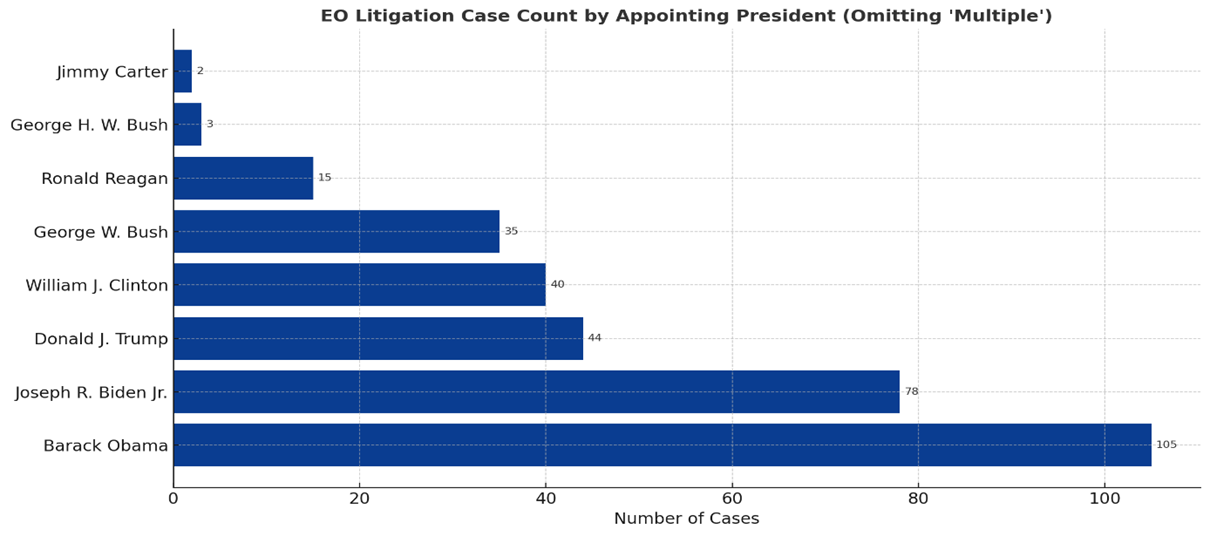
Our analysis includes a comprehensive dataset from the "EO Litigation Tracker," detailing 327 federal district court cases against executive orders up to mid-August 2025. This tracker categorizes cases by issue area, judge, type of injunctive relief sought, and outcomes, revealing a nuanced judicial landscape.
A notable pattern emerged from the data: judges appointed by Presidents Barack Obama and Joseph R. Biden Jr. handled the majority of these cases, reflecting more about strategic filing locations than judicial bias. The outcomes were telling: approximately 85% of cases resulted in the EO being enjoined in whole or part, demonstrating significant judicial pushback regardless of the appointing president.
The emerging litigation pattern highlights strategic lawsuit locations such as the District of Columbia, chosen for its judges' familiarity with administrative law and national policy implications. In contrast, states like Texas, previously central to policy disputes, saw fewer cases, indicating a strategic shift by liberal states and advocacy groups towards more favorable jurisdictions.
This judicial review of executive orders, while not new, underscores the ongoing tension between different government branches and highlights the courts' critical role in shaping national policy. As the Supreme Court prepares to refine the rules surrounding executive authority, it is clear that any significant executive action will likely encounter judicial scrutiny first.
For those following these developments, the detailed analysis in the EO Litigation Tracker offers invaluable insights into the complex interplay between executive intentions and judicial interpretations. As the legal battles over executive orders continue to unfold, they will undoubtedly shape the landscape of American governance in significant ways.
For more in-depth analysis and updates on this ongoing legal saga, follow developments on the specialized legal analytics platforms.