January 14, 2026
Supreme Court Hacked, Proving Its Cybersecurity Is As Robust As Its Ethical Code
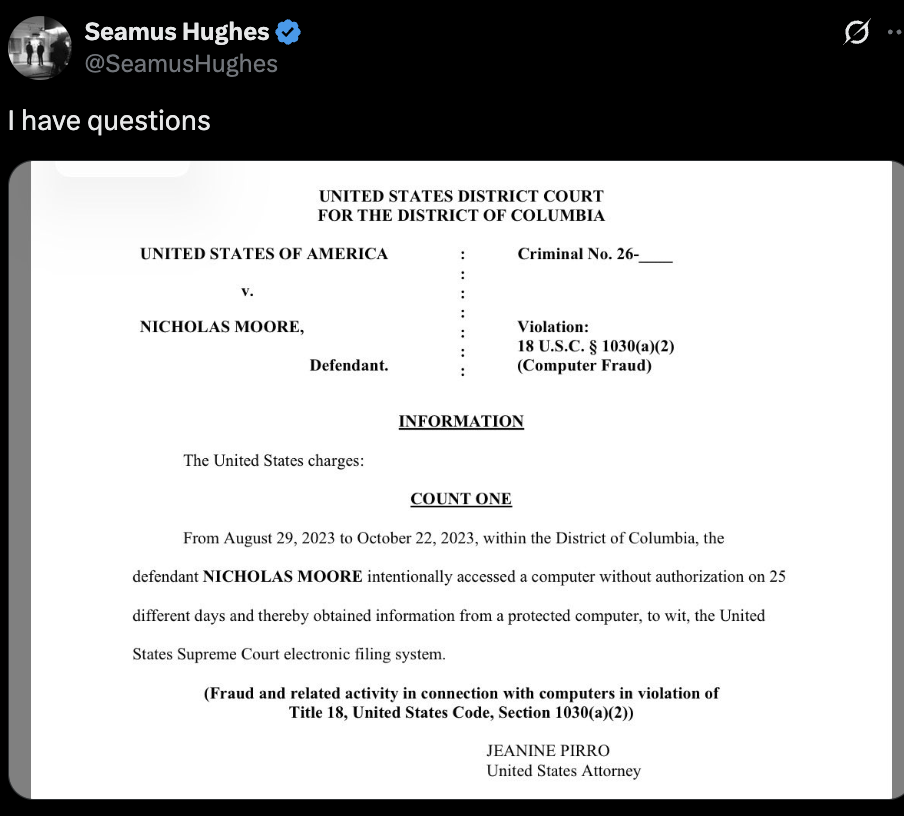
In a turn of events that underscores the fragility of digital fortresses, the Supreme Court's cybersecurity measures have been breached, not by a seasoned cybercriminal, but by a 24-year-old from Springfield, Tennessee. Nicholas Moore, the young hacker, managed to infiltrate the Supreme Court’s electronic filing system an astonishing 25 times over two months. This startling revelation brings to light not just the ease of digital trespassing but also the slow pace of response from one of the highest courts in the land.
The incident, first brought to public attention by Court Watch’s Seamus Hughes via a post on X, has quickly become a focal point of discussions concerning the adequacy of cybersecurity protocols at national judicial levels. The breach involved Moore accessing the electronic filing system, a repository of legal filings, rather than more sensitive communication channels within the Court. Although the breach did not extend to email or internal document management systems, the potential exposure of sealed documents poses a significant concern.
The legal framework surrounding this breach falls under the Computer Fraud and Abuse Act (CFAA), a favorite tool of prosecutors dealing with unauthorized digital access. The CFAA's broad "unauthorized access" provision means that even unintentional policy violations can lead to serious charges, underscoring the act's wide net. Despite its intended use to combat serious cyber threats, the act often faces criticism for its application in less clear-cut scenarios.
This event marks yet another challenging episode for the federal judiciary's battle with cybersecurity. It follows previous incidents, such as the breach by Russian government hackers of the broader federal court filing system. These breaches highlight ongoing vulnerabilities and raise questions about the judiciary's commitment to modernizing its cybersecurity measures.
As the judiciary purportedly works on enhancing its cybersecurity protocols, incidents like these serve as a stark reminder of the constant evolution of cyber threats and the need for continual reassessment of digital defenses. Whether the Supreme Court and related bodies will manage to fortify their digital gateways effectively remains to be seen. But for now, the focus is on the implications of this breach and the lessons it imparts about the intersection of law, technology, and security.