February 2, 2026
Federal Court Ruling Increases Costs for ICE in Wrongful Detention Cases
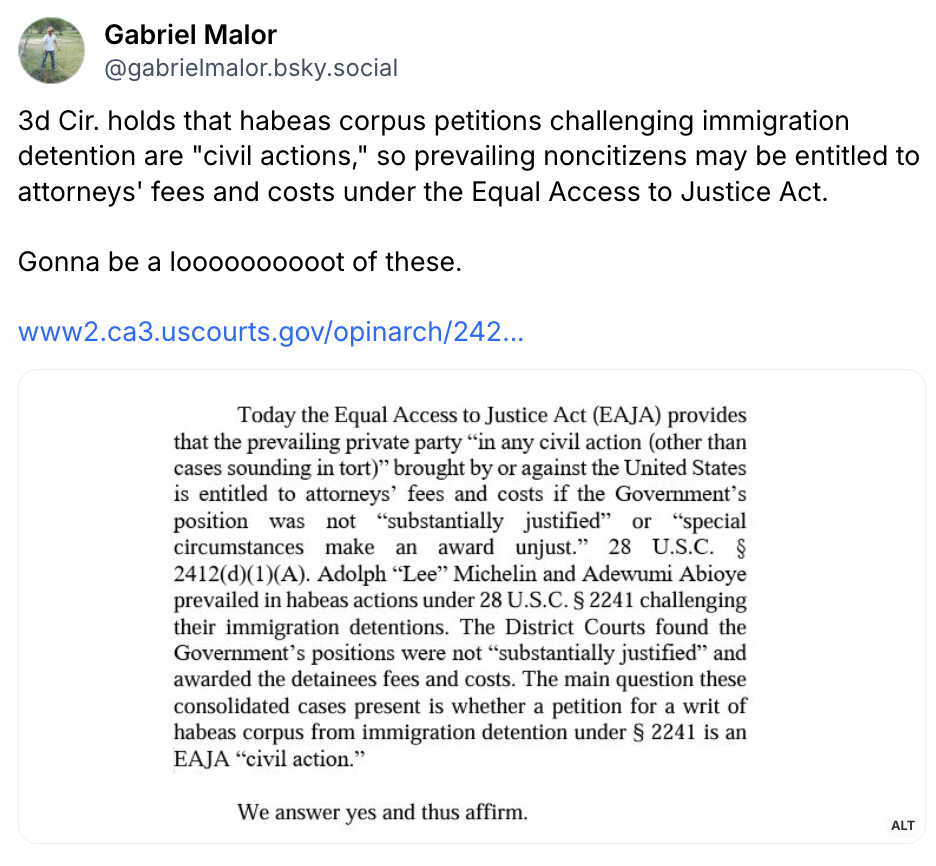
In a landmark decision by the Third Circuit, it has become significantly pricier for the U.S. Immigration and Customs Enforcement (ICE) to wrongfully detain individuals. The court ruled that successful habeas corpus petitions by immigrants detained for prolonged periods without bond hearings are entitled to attorney's fees under the Equal Access to Justice Act (EAJA). This marks a pivotal shift in the financial and operational dynamics of immigration enforcement.
The case, known as Michelin v. Warden Moshannon Valley Correctional Center, involved two immigrants who had been detained—one for over a year and the other for 16 months—without the opportunity for bond hearings. Upon winning their habeas petitions, they sought legal fees, sparking yet another legal battle as the government attempted to exempt habeas corpus from being considered a 'civil action' under the EAJA.
The court, however, firmly held that a petition for a writ of habeas corpus has always been treated as a civil action, dismissing the government's argument of it being a 'hybrid' proceeding. The ruling emphasized that in matters of immigration detention, all elements are distinctly civil, thereby warranting the application of the EAJA.
This interpretation by the Third Circuit could pose a costly challenge to ICE, particularly if other circuits adopt a similar stance. The government often relies on a volume strategy in its immigration enforcement tactics, where numerous cases are handled en masse. Now, each case where ICE is forced to pay attorney fees could add up, potentially altering how immigration laws are enforced to avoid financial drains.
The decision also opens up a potential avenue for the Supreme Court to address due to the circuit split on this interpretation. The Third Circuit's opinion underscored the historical significance of the writ of habeas corpus as a foundational mechanism to ensure due process—a principle that the court noted should remain robust today.
This ruling comes as a reminder of the judiciary's role in checking excessive or arbitrary detention practices by executive agencies. It raises critical questions about the balance of power, the interpretation of law, and the fiscal impacts of legal strategies employed by government agencies against individuals challenging wrongful detentions. As this legal battle unfolds, it may set significant precedents for how immigration detainees are treated under U.S. law, influencing both policy and practice moving forward.