February 17, 2026
Pentagon Targets Top Law Schools in Anti-Woke Crusade, Raising Concerns About Military's Intellectual Future
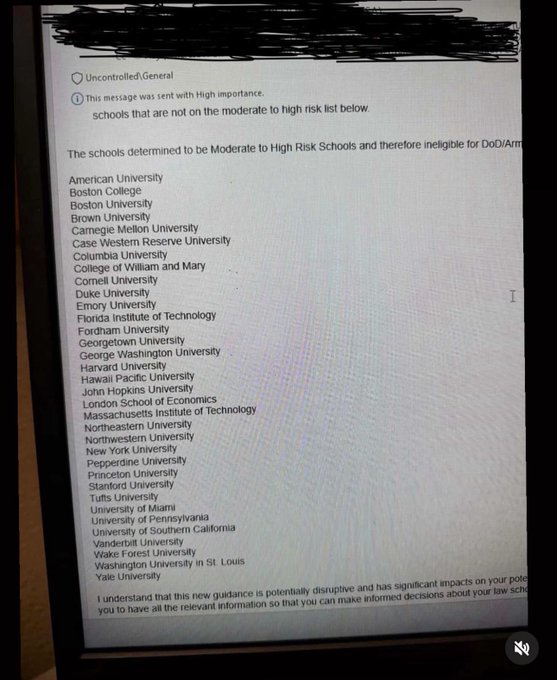
In a move that has stirred controversy and concern, the Pentagon has declared over 30 elite universities "moderate to high risk," effectively banning them from Department of Defense (DOD) tuition assistance programs for future military lawyers. This decision is seen as a continuation of the DOD's recent anti-intellectual stance, further evidenced by its earlier severance with Harvard University.
The affected programs, the Funded Legal Education Program (FLEP) and the Unfunded Legal Education Program (UFLEP), have sent shockwaves through the military legal community. An internal email urgently advised FLEP candidates to withdraw applications from the blacklisted institutions, a list that curiously includes several universities that do not even have law schools, such as Brown and Princeton.
This exclusion extends to all but one of the prestigious T14 law schools, sparing only the University of Chicago, along with top public law schools like Berkeley, Michigan, and UVA, which are also under threat of being banned.
Critics argue that this policy could severely undermine the quality of legal expertise within the military. Top-tier law schools not only provide rigorous academic training but also encourage critical thinking and a broad worldview—qualities essential for effective military leadership and legal acumen.
The DOD's rationale appears to pivot on an objection to what it terms "globalist and radical ideologies" at these institutions. However, this sweeping generalization fails to recognize the nuanced and diverse perspectives that such schools offer, which can enrich the military's strategic and legal operations.
A military source, speaking to CNN on condition of anonymity, criticized the DOD's approach as a "purge of intellect, diversity of thinking, and critical thought from the military," pointing out that shielding military personnel from diverse ideas is both "delicate" and "short-sighted."
This policy not only risks a decline in the quality of military legal personnel but also potentially alienates bright candidates who may now look to the private sector or other avenues where their credentials are more valued. This could lead to a significant brain drain at a time when the U.S. military can ill afford it.
The broader implications of such educational restrictions are profound, raising alarms about the future of military leadership and the caliber of officers and legal advocates it produces. As the debate unfolds, the Pentagon's move is a reminder of the delicate balance between national security and intellectual freedom—a balance that must be carefully managed to safeguard the nation's future both at home and on international fronts.