March 5, 2026
The Billable Hour Faces Its Toughest Challenger Yet: Artificial Intelligence
The billable hour, a cornerstone of legal billing practices, may finally be facing its reckoning—not from market pressure or client demand, but from the surge in Artificial Intelligence (AI) within the legal industry. The 2026 Legal Industry Report, released this morning by 8am.com, unveils compelling insights from more than 1,300 legal professionals, spotlighting a seismic shift in how law may be practiced henceforth.
AI's integration into legal workflows has skyrocketed, with usage doubling over the past year—now 69% of legal professionals utilize tools like ChatGPT, Gemini, and Claude. This adoption is not just about keeping up with tech trends; it's reshaping the very fabric of legal billing. Lawyers are reporting significant time savings, with 38% saving between one to five hours weekly, and 14% even more. This newfound efficiency begs a crucial question: What happens to the billable hour when AI performs tasks in less time than humans?
The answer might lie in evolving billing models. Nearly half of the surveyed lawyers anticipate changes in how they bill, with many expecting a move towards flat fees or alternative arrangements. This shift could mitigate potential revenue losses from reduced billable hours, which could otherwise tally up to $144,000 annually per lawyer.
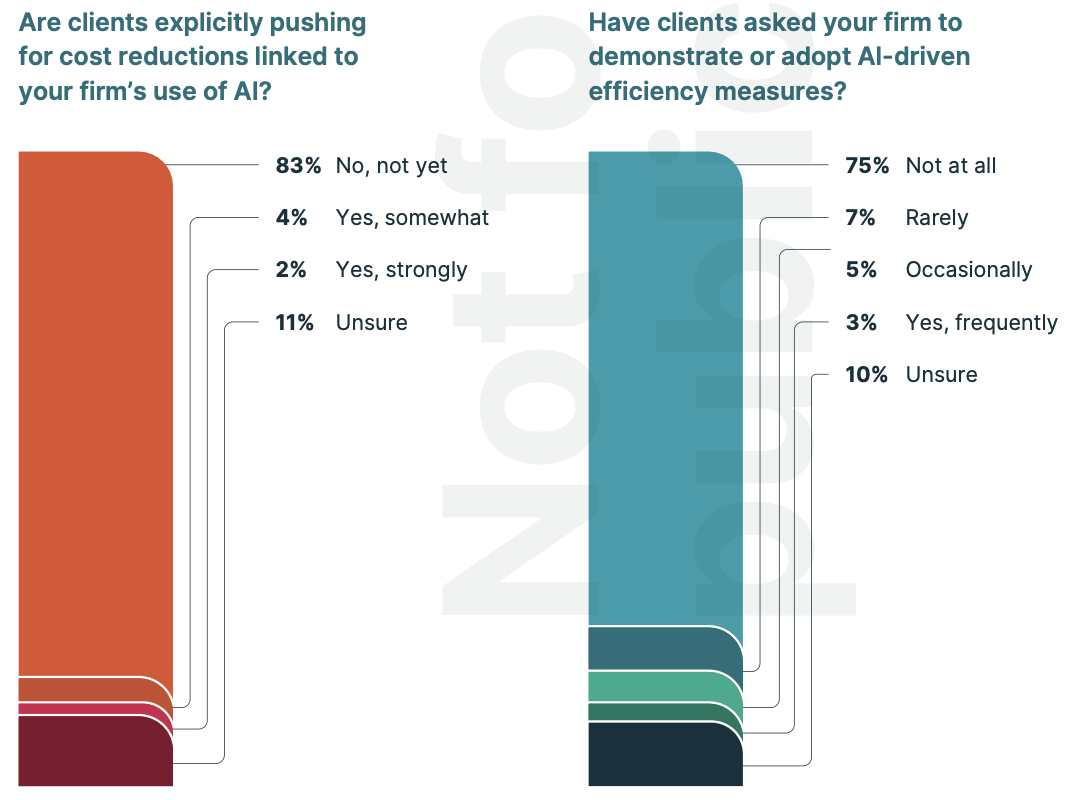
Surprisingly, client demand for AI-driven cost reductions hasn't materialized as expected. Instead, 83% of lawyers report no significant pressure from clients for price drops due to AI efficiencies. This opens a strategic window for law firms to restructure their billing without immediate backlash, aligning costs more closely with value rather than time—a model that could sustain or even increase revenue while embracing technological advancements.
Moreover, the report sheds light on a grim reality—the state of access to justice remains bleak, with most lawyers rating it poorly. High costs are seen as the primary barrier, and there's a strong consensus that more funding for legal aid could ameliorate this. Herein lies an indirect yet potent impact of AI adoption. By automating routine tasks and saving valuable time, lawyers could redirect hours towards pro bono work, thus potentially narrowing the justice gap without sacrificing firm profitability.
The conversation around AI in law often focuses on direct applications like enhancing pro bono services or improving efficiency. However, the broader implications on billing practices and access to justice suggest a dual benefit: maintaining law firms' financial health while increasing their capacity to serve underrepresented populations.
As technology continues to evolve, the legal industry stands at a crossroads. Can it adapt its business model to harness AI's full potential, both as a tool for efficiency and an instrument of greater societal good? Only time will tell, but the current trajectory offers a hopeful glimpse into a more accessible and equitable legal system.