July 9, 2026
Trump Labels Supreme Court 'Absolutely Insane' Following Birthright Citizenship Ruling, Seeks Redo
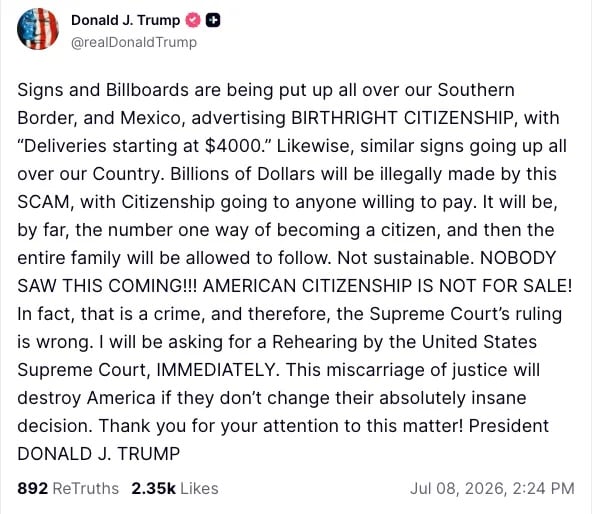
In an unprecedented move that has legal commentators and the public alike astounded, former President Donald Trump has demanded a second chance from the Supreme Court to revisit the birthright citizenship case, Trump v. Barbara, immediately after its recent judgment. The Court's decision, which upheld the longstanding interpretation of the Fourteenth Amendment, was described by Trump as "absolutely insane" and a "miscarriage of justice."
Despite the clarity of the Fourteenth Amendment regarding birthright citizenship, the case had stirred unexpected controversy due to the "Eli Cash Doctrine" embraced by several justices, leading to a controversial dissent led by Justice Clarence Thomas. Thomas's extensive dissent, criticized as a "collection of nativist fan fiction," ultimately did not influence the ruling, affirming that birthright citizenship remains protected and cannot be altered by executive order.
Trump, who once boasted about the incessant winning his administration would achieve, appears disillusioned by the legal setbacks, especially with the Supreme Court. His call for a rehearing on his Truth Social platform, however, is likely to be in vain. Legal expert Steve Vladeck has pointed out that the Supreme Court has not granted a rehearing on argued cases that would reverse its decision since 1956, with procedural and substantial hurdles making such an occurrence highly unlikely today.
Adding to the complexity, Trump's critique of the Supreme Court comes amid baseless allegations that regional hospitals are enticing migrants with low-cost obstetric services, a claim widely regarded as another layer of his ongoing immigration rhetoric. This posture not only reflects Trump’s continued influence over certain political narratives but also highlights a strategic persistence to challenge established legal norms.
The prospects for a rehearing are further dampened by the requirement that such a motion must be initiated by a justice who concurred with the judgment, a procedural nuance that leaves Trump’s demand almost certainly unmet. Moreover, the political undertones of the request suggest a deeper attempt to reshape judicial precedents that have long been considered settled law.
As the saga unfolds, the legal community and observers remain skeptical of the motion's success but attentive to the implications of Trump's relentless pursuit to overturn established legal frameworks. The situation underscores the ongoing tensions between Trump's political strategies and the foundational principles of American jurisprudence.