July 10, 2026
AI and Efficiency: Small Law Firms See Increased Billing Hours Despite Technological Advances
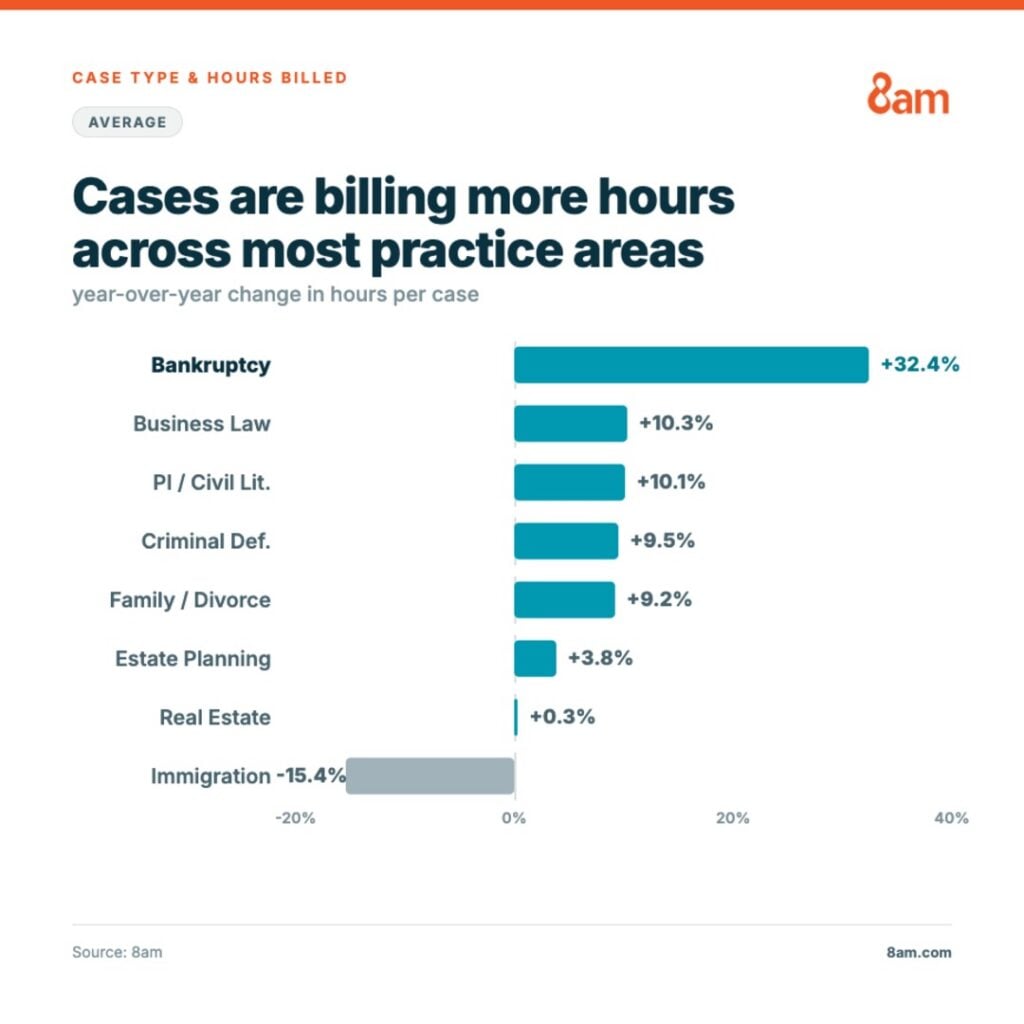
Artificial Intelligence (AI) has been heralded as a transformative force across industries, promising unparalleled efficiency and a new way of conducting business. However, recent findings suggest that for small law firms, the reality of AI integration may not be living up to its lofty expectations. According to a new report from 8am, titled the SMB Law Financial Health Report, small law firms are experiencing an increase in hours billed per case, contrary to the efficiency gains AI was supposed to deliver.
In March, 8am’s 2026 Legal Industry Report painted a rosy picture, with over 1,300 legal professionals reportedly saving between six to ten hours weekly thanks to AI. A mere 6% reported no productivity benefits from AI, a significant drop from 16%. However, the latest data from the SMB Law Financial Health Report, which analyzed several million bills from April 2024 to March 2026, tells a different story. It revealed an uptick in hours per case in nearly every practice area, ranging from a modest 3% to a whopping 32% in bankruptcy cases.
The anomaly of immigration cases, where billing is tougher due to external factors like government interference, stands out. But across the board, the increase in billed hours suggests that either AI adoption is not as widespread and effective as anticipated, or the technology is not yielding the expected efficiency improvements.
One silver lining in the report is the financial compensation aspect. Despite the increase in hours, small law firms have seen a rise in billed dollars per hour, from $262 to $274, indicating that the additional hours are indeed translating into real billable work and not just inflated figures due to automated timekeeping. Particularly, firms with four to five attorneys, where AI marketing has been most aggressive, are seeing the most significant financial benefits.
Moreover, small law firms are excelling in their collection rates. The 8am report highlighted an improvement from 58% to 63% in the share of invoices collected within 30 days, with some firms receiving payments the same day they bill. This is in stark contrast to larger law firms, which are struggling with slower collections despite higher rates.
The integration of convenient payment options, such as online payments and autopay plans, has significantly boosted these rates. For instance, autopay plans on bills over $5,000 are recovering 79 cents on the dollar compared to 38 cents without such plans.
While AI has not yet consistently delivered on its promise of efficiency in small law firms, the technology and methods of integrating it are continually improving. As the industry evolves, there is hope that AI will eventually live up to its potential, helping lawyers not just in managing their time better but also in enhancing their bottom lines. For now, small law firms can take solace in the fact that while they may be working more, they are also earning more, and more efficiently collecting what they earn.