July 10, 2026
Trump Calls for Supreme Court Reversal on Birthright Citizenship Decision
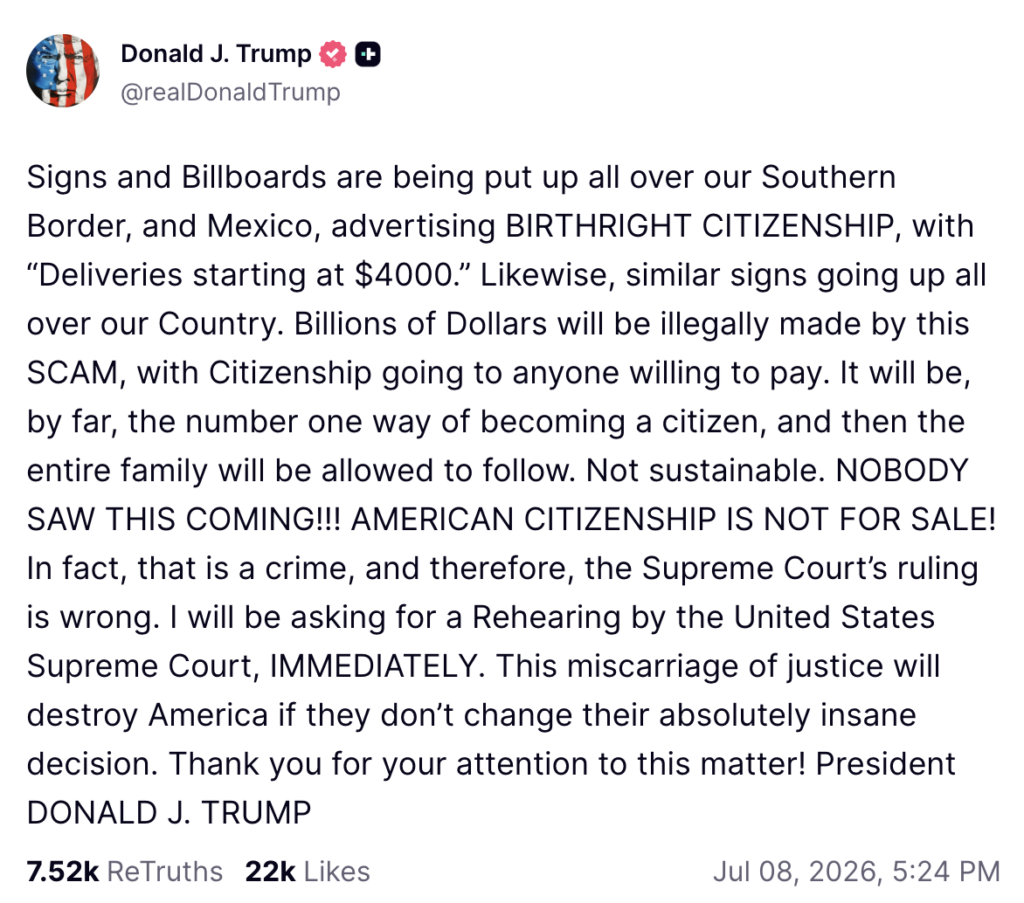
In an unprecedented move that has stirred significant controversy, former President Donald Trump has publicly demanded that the Supreme Court reconsider its recent decision on birthright citizenship. This rare request for a rehearing from the highest court in the land marks a significant escalation in Trump's long-standing opposition to current immigration laws, specifically targeting the 14th Amendment which grants citizenship to all persons born or naturalized in the United States.
Earlier this week, Trump took to social media to express his dissatisfaction with the Supreme Court's ruling, labeling it as a "miscarriage of justice" that would "destroy America" if not overturned. His call for an immediate rehearing adds another layer of intensity to his campaign against what he perceives as flawed judicial processes.
The focus of Trump’s ire, the birthright citizenship, has been a cornerstone of constitutional rights in the U.S., ensuring that all individuals born on American soil are automatically citizens, regardless of their parents' nationality. This principle was one of his notable defeats this term, sparking a vehement response from the former president.
Legal experts are skeptical about the potential success of a rehearing, pointing out that the Supreme Court generally only grants such requests under extraordinary circumstances. Furthermore, Trump's aggressive approach may not sit well with the justices, who are accustomed to more traditional legal arguments and procedures.
In response to the Supreme Court's decision, Trump's legal team might explore alternative strategies. One such theory, previously hinted at by conservative Judge James Ho, suggests treating children of certain foreign nationals as if they are part of an "occupying army," thus not protected under U.S. law. This controversial stance would likely face significant legal challenges.
Trump's demand for a rehearing coincides with his other ongoing legal battles, including the defamation case brought against him by E. Jean Carroll. Despite facing setbacks in these cases, Trump's legal team continues to press forward, repeatedly challenging adverse decisions and exploring all available legal avenues, albeit with mixed success.
The situation puts Solicitor General John Sauer in a precarious position, as he must balance professional integrity with the pressures of responding to Trump’s demands. The outcome of this legal maneuvering remains uncertain, but it highlights the persistent tensions and political undercurrents influencing the U.S. judicial system.
As the country watches closely, the Supreme Court's response to Trump's appeal for a rehearing will not only affect the former president's legal strategy but also set a significant precedent for how similar cases might be handled in the future. The implications extend beyond the courtroom, touching on the broader issues of immigration, citizenship, and constitutional rights in America.