July 14, 2026
Supreme Court Faces Criticism Over Lack of Transparency in Decision-Making Processes
Today, Supreme Court Justices Elena Kagan and Amy Coney Barrett appeared before Congress to request a significant increase in security funding for federal judges, citing documented threats primarily aimed at lower court judges who have ruled against the Trump administration. While the request includes funds for enhanced cybersecurity measures, the primary focus is on protecting judges from potential violent attacks.
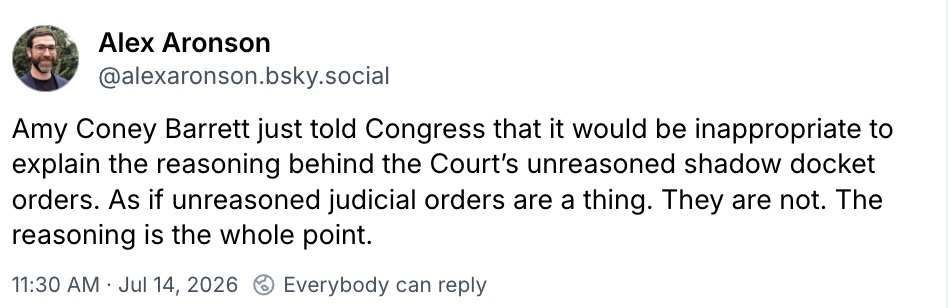
The rare congressional testimony by the justices touched on several topics, including the controversial practice of issuing decisions via the shadow docket—decisions made without public argument or detailed written explanation. Justice Barrett, who previously urged the public to "read the opinion" to understand the Court's reasoning, now seems to hold a different stance, suggesting it's inappropriate to expect the Supreme Court to explain its decisions.
The shadow docket has been used to issue expansive orders on a range of issues, from abortion to voting rights, often without the detailed reasoning that accompanies regularly argued cases. Critics argue that this practice not only undermines transparency but also allows the Court to implement changes without a full accounting of its legal reasoning, echoing Justice Barrett's earlier remarks that emphasized the importance of reasoned judgment.
Justice Gorsuch recently emphasized that lower court judges must adhere to the Supreme Court's decisions, even those delivered through the shadow docket, indicating a significant shift in how these orders are perceived within the judicial hierarchy. This expansion of the shadow docket's authority has sparked debate and criticism, particularly as it seems to serve the immediate policy preferences of the majority without the burden of detailed justification.
Furthermore, the Supreme Court's reluctance to provide explanations has been linked to an increase in violent threats against judges, as unexplained decisions can portray lower court judges as politically biased, particularly in cases involving the Trump administration.
The request for increased security funding and the ongoing use of the shadow docket highlight a critical tension within the highest court between maintaining judicial security and adhering to the principles of transparency and accountability. Critics argue that the Court's actions, without thorough explanations, threaten the very legitimacy of the judiciary, which relies on reasoned opinions to wield its authority effectively. As the debate continues, the Supreme Court's approach to transparency remains a pivotal issue in its relationship with the public and its adherence to the rule of law.