July 28, 2026
Trump Misses Deadline for Promised Supreme Court Rehearing on Birthright Citizenship
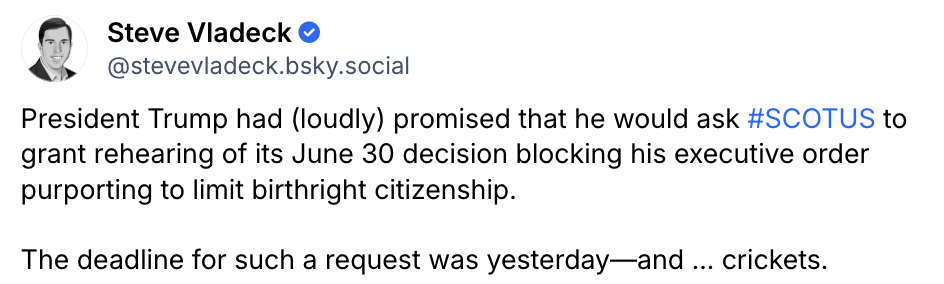
In a surprising twist that may leave many shaking their heads, former President Donald Trump has failed to file a promised request for a rehearing on the issue of birthright citizenship before the Supreme Court's deadline. This development follows a series of bold, public assertions by Trump decrying the Court's previous ruling, which upheld the Fourteenth Amendment's guarantee of citizenship for all born on U.S. soil.
Despite Trump's vocal criticisms and his call for a legal "do-over," the deadline came and went without action from his legal team. This inaction casts doubt on the feasibility of his claims and on the administration's commitment to overturning established constitutional rights.
Trump had previously highlighted a Texas hospital's supposed advertisement offering to assist migrants in giving birth in the U.S., which he claimed was a repercussion of the Court's decision. However, this account was quickly debunked as the advertisement dated back to 2021, well before the recent Supreme Court ruling.
Speculation abounds on why Trump's team failed to meet the deadline. Some suggest the mishap could be due to ongoing challenges within his legal team, notably surrounding Todd Blanche. Blanche, a key legal figure in Trump's circle, has faced repeated setbacks in Senate confirmations, which could have distracted from the timely filing of a rehearing request.
Alternatively, a simple miscounting of days by the Solicitor General's office has been floated as another potential reason for the missed deadline.
This event marks yet another chapter in Trump's contentious relationship with the judiciary. The Supreme Court, which rarely grants rehearings, last did so in 1965, making Trump's initial push for a do-over a long shot. The last successful reversal following a rehearing occurred in 1956, emphasizing the historical improbability of his quest.
As the political spectacle continues, this latest episode serves as a reminder of the complexities and often unpredictable nature of legal and political strategies at the highest levels of American governance.