August 25, 2026
In High-Stakes Legal Matters, "Probably Right" Falls Short: The Case for Deterministic AI
In the rapidly evolving landscape of legal technology, the integration of artificial intelligence (AI) has promised swifter workflows and enhanced efficiency. However, when it comes to complex, high-stakes legal work, AI's speed often becomes irrelevant, overshadowed by the need for absolute accuracy.
AI tools predominantly operate on probabilistic models—essentially educated guesses. While suitable for routine tasks, this approach proves inadequate for intricate legal matters where a single oversight could have significant repercussions. The fallout is not just a potential error but a 'verification tax'—the time lawyers must invest in meticulously checking AI-generated outputs, searching for errors that could have been introduced by the AI itself.
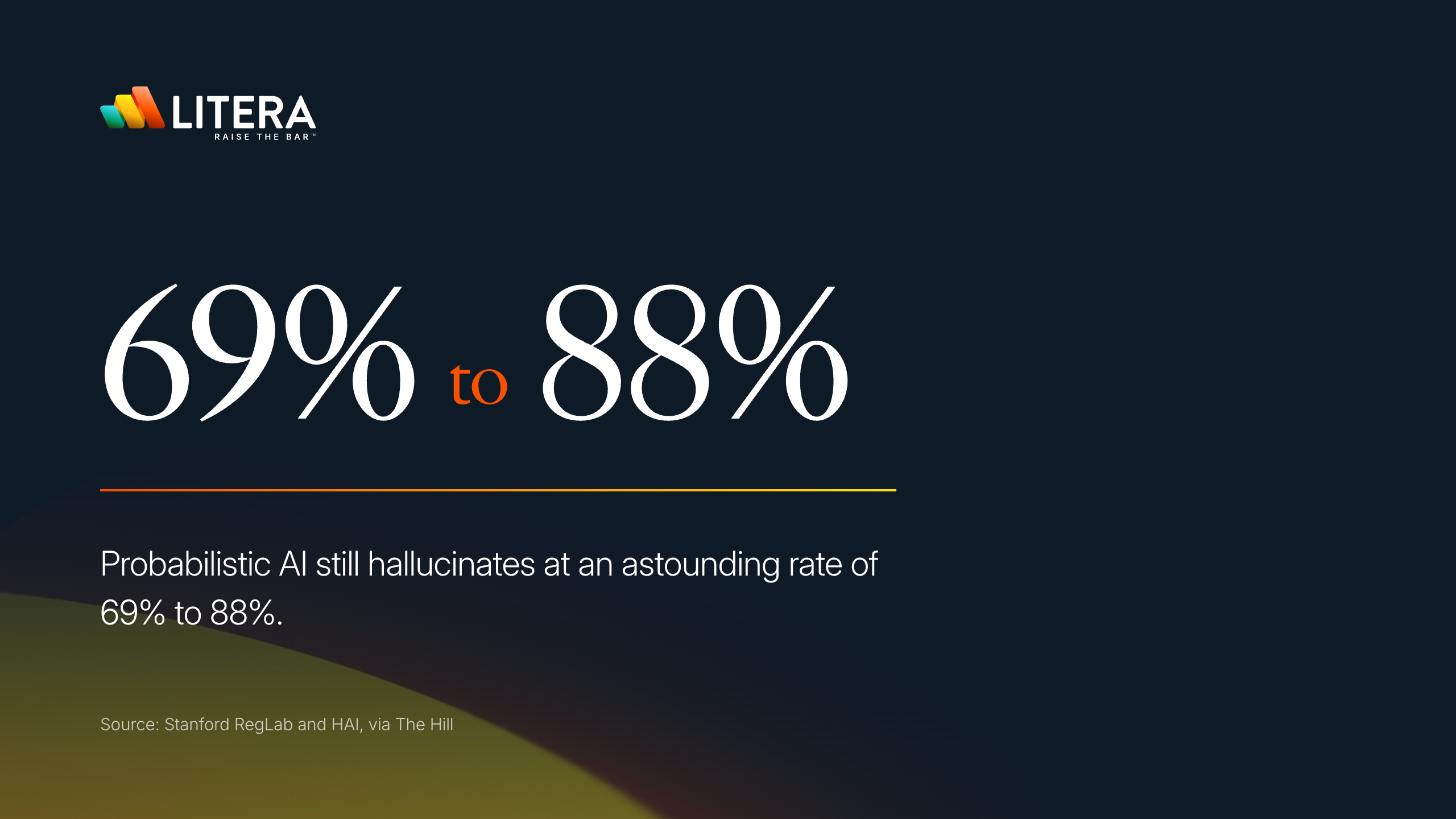
This verification process negates the efficiency AI is supposed to bring, especially when AI models, according to recent studies, experience hallucination rates as high as 88%. This lack of reliability has led to a hesitance among legal professionals, with only 39% trusting the results enough to implement AI in sensitive tasks, and a mere 6% of clients feeling assured of the AI-enhanced quality delivered by their legal service providers.
The heart of the issue lies in the distinction between deterministic and probabilistic AI. Unlike its probabilistic counterpart, deterministic AI operates on fixed rules, delivering the same correct output for the same input every time. This predictability makes deterministic AI a safer bet for tasks that require exactness, such as detailed contract reviews where precision is non-negotiable.
Yet, the legal industry faces another challenge: fragmentation. Most AI tools are designed to optimize one particular step of a legal process—be it drafting, reviewing, or managing transactions—leading to a scattered workflow that requires lawyers to constantly switch between different systems. This not only disrupts the workflow but also introduces more room for error, as lawyers must piece together information from various sources.
A comprehensive solution lies in platforms that can handle all aspects of complex legal matters, from initial drafting to final transactions, with deterministic accuracy at every step. Such platforms ensure that accuracy is not just maintained but compounded through each phase, transforming efficiency into deep client trust and firm growth.
Litera is an example of a platform that has embraced this holistic approach. By integrating deterministic AI with sophisticated GenAI for tasks where nuanced language and speed are beneficial, Litera offers a connected solution that ensures high accuracy and reliability across all stages of legal work. This not only speeds up the process but also enhances the quality of the output, making the legal practice not just faster but fundamentally better.
In conclusion, as AI continues to permeate the legal field, the focus must shift from merely achieving speed to ensuring unwavering accuracy and trust. In high-stakes matters, where the cost of an error can be immense, "probably right" is simply not good enough. The future of legal AI depends on its ability to deliver deterministic precision that legal professionals and their clients can rely on without reservation.